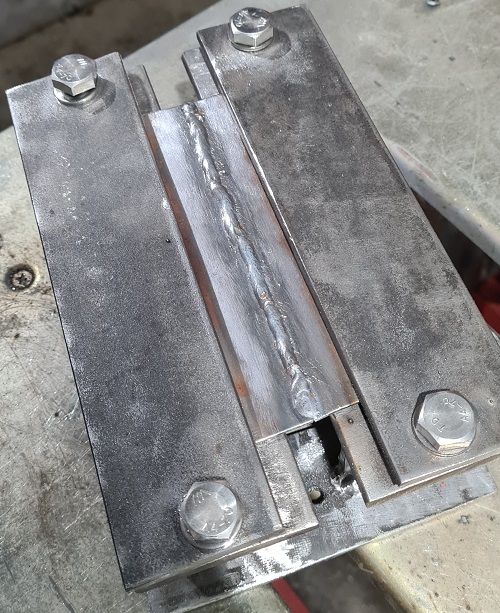
these are just some things I've been told and/or worked out as I've gone along, they might help to get you started
Dialling in settings:
some interesting pointers I've learned about this, firstly there's a really good app on play store, miller weld I think it's called, you can choose your machine type, and material type + thickness and it'll give you a good starting point
so first you want to set up your welding kit on a bit of scrap the same type and thickness
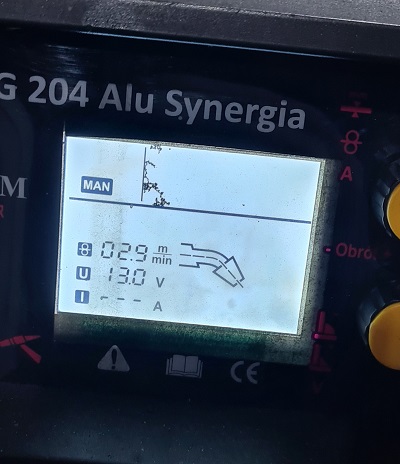
firstly, just hold the nozzle really still, about 8-10mm from the surface, and weld a blob onto the metal, trigger, let go and don't move wait a sec, then move your hand. the reason being, the machine is quite capable of adjusting power to maintain the arc despite your very slight hand movements, and it will continuously do so. So, if you weld your 'blob' and then lift a bit as you stop, it adjusts a little and you get a false reading on the display. keep doing that and adjusting until you're happy with the amps (which are obviously a result of wire speed and volts)
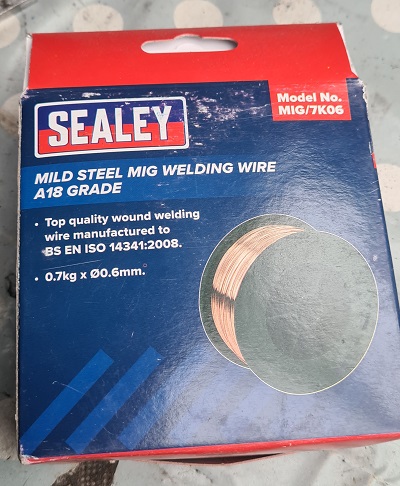
for 0.8mm sheet (with 0.6mm wire) I've been settting to about 13-14v, and playing with wire speed until I get about 40-45amps, because lower amps tends to mean slower wire speed and not getting the right arc consistency)
- blowing through, turn it down
- more on top than underneath, turn it up
- if it's penetrating right, but you're getting a lot of spitting and spatter then you can up the volts a bit instead and bring wire speed down (maintaining same amps)
- if your wire speed is too low you'll get an intermittent arc and just a lot of airy hissing noise, turn the wire speed up and compensate by lowering volts (maintaining same amps)
spend time on that, find the right settings until you're getting build-up the same on top as you are underneath, no blow-through and a continuous sizzling bacon sound
Position / angle:
torch head at about 70degrees (should mean torch handle parallel to the sheet, hence the design of the torch angle)
'stick out' (length of wire from tip before you start) something like 8-10mm
get the nozzle right down so it's literally just hovering above your weld bead as you move along, don't lift up as you move along which is something that can naturally happen
before you actually do the weld, just 'fake' it first, without pulling the trigger - watch closely and see if you're naturally moving away from the right place as you move along (before you add darkened mask to the equation)
Practice runs:
push, don't pull
pretty obvious really but just welding a run onto a flat sheet along a straight line is the first goal, the aim here is moving slow enough to get a nice even and consistent bead, but fast enough to not keep blowing holes. I reckon on this thin stuff I'm probably moving about 1cm per second (possibly a bit quicker even), so maybe get a pencil and start drawing weave patterns first to try and match that speed as a starting point
like this
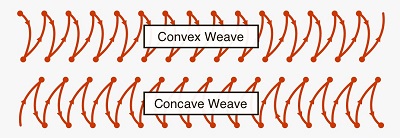
you might find it's easy to wander off-line because when the mask darkens, it's not easy to follow a little scribed line. lightly run a grinder or dremel along it if you like, it will make it easier to see and follow with the mask on
Once you're getting nice continuous runs in that way, cut a series of slits into a bit of sheet and start welding them back up again. the benefit of that is you'll have nice even gaps to fill, and it takes clamping and positioning out of the equation to start with. And now you're practising welding two open edges which will increase the chances of blowing holes again. modify your movement speed to stop that happening, maybe adjust settings down if you need.
If you cut those slits right to the edge as well then you get to practice welding up to the edge, good luck with that lol (when going up an edge you can use a bit of scrap as a run-off plate, weld into that, then cut it off again, handy little pointer that)
after you've done a series of tacks, when you start filling in between, start on a tack each time (or on previous weld) because the initial arc-up will easily blow holes. starting on the slightly thicker point where there is tack or weld essentially sinks away some of that inital heat in a place when it can handle it. then get moving. quick
don't do more than say 1/2" to 3/4" at a time, cool in between (wait for red to go away) you should get away with minimal warping (but don't worry this is the whole point of practice runs)
Hand positioning:
Steadiness is critical (or at least helps hugely) use your off-hand like you do in snooker to steady the tip. lean your elbow down on something to be stable as well if you can. or, tucking your elbows in to your ribcage as you go makes you more steady as well, sort of locking yourself in position
actually holding the tip with the thumb and first finger of your left hand, while resting on the heel of that hand, can give you really precise and accurate movement although it's "not good practise" (well. in my book, if it works it works)
that trick doesn't really work so well on thick stuff when you want to just do a long run all the way along as you have to keep awkwardly re-positioning your hand. for that I have a sort of 'snooker left hand with walking fingers' technique to keep my position right. But we're only doing short bursts, not covering a lot of distance each time
when I do this I'm basically using my left/off hand at the nozzle to provide the forwards movement, and the right/main hand on the torch handle to make the left/right sort of rotational movements (like revving a bike very slightly)
--------------
I know that's a lot to take in .. but hopefully there's at least one of two things in there that might help someone
Edited by stuart bowes, 25 August 2026 - 09:57 AM.