

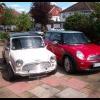


Auto-Express (Jan 2026) - "The automotive landscape has changed dramatically over the past 30 years. To celebrate, we name the 50 models that we think illustrate the transformation best. The Auto-Express team has racked its brains, argued into the night, and come up with a list of cars on sale at the millennium or beyond that have transformed modern motoring in terms of design, technology, concept or commercial performance. This is our list of the 50 modern cars that changed the world. Do you agree? Let the countdown – and debate – commence!"
https://www.autoexpr...anged-the-world
No.2 - MINI (No. built: 5 million, From: 2001-present, Price: from £500)
"Reviving icons is big business in the automotive industry. Cars like the Fiat 500, Volkswagen Beetle, Renault 5 and VW ID. Buzz all try to play on customers’ fondness for popular classics, but none have done it quite as convincingly as BMW’s MINI.
Mini’s previous owner, British Leyland, had a few stabs at creating a replacement with the ill-fated ADO74 and ADO88 projects. Then in 1995, BMW and Rover drew up plans for a new model. Rover had three designs: the Evolution and Revolution were practical, conventional hatchbacks, while the Spiritual was a rather wacky-looking rear-engined creation. BMW’s alternative was the MGF-based ACV30 from Adrian van Hooydonk.
Frank Stephenson eventually came up with a winning design, which was shown off in concept form at the 1997 Frankfurt Motor Show, casting a retro-shaped shadow over the unveilings of two other new small cars: the Mercedes A-Class and Smart ForTwo. Bringing some affirmation to the event was John Cooper, who helped realise the original Mini’s capacity for motor racing in the sixties. He remarked “it looks like a Mini. It’s a little bigger, but I think the team at Rover have done a wonderful job.”
The final production car at the Paris Motor Show in 2000 looked almost identical to Stephenson’s concept. The round, chrome-rimmed headlights, pillarless exterior glass, clamshell bonnet, floating roof and retro-inspired interior with old-school toggle switches and the central speedometer gave the new MINI a distinctive, yet familiar look with the premium appeal BMW wanted from the off. The exhaust tip, which was conceived in a matter of minutes by Stephenson hurriedly sticking an empty beer can into the back of the clay model, gave the MINI even more character.
Graham Biggs, who worked in the MINI press department during the car’s launch, told us what it was like to announce an iconic car like the new MINI on the world stage: “There was massive expectation when it came to the new MINI. The sense of responsibility for us was also absolutely huge.” Thankfully for Biggs, MINI and BMW, the response was overwhelmingly positive. “When we pulled the covers off, the initial reaction was just ‘wow’. Frank Stephenson got the design and the proportions absolutely right.” During the first test drives of the new MINI in 2001, Biggs recalled the buzz around the car: “The venue for the UK drive was the Great Eastern hotel in London. Surrounding offices emptied, with crowds coming to stand and look at our row of cars. Some even went to a dealer around the corner and immediately put deposits down.” At a keen price point of £11,600, the Cooper was priced above mainstream rivals such as the Peugeot 206, Renault Clio and Ford Fiesta, but the MINI’s sheer style and charm made them look unworthy of the new millennium.
The design of the MINI has been such a success that most of the cues remained for subsequent versions, as well as new models such as the Clubman, Countryman, Aceman and Paceman. But it needed more than good looks to be a hit. It had to be a hoot to drive. The supercharged Cooper S and Works GP were absolute riots, but the fun wasn’t just restricted to the hot hatch variants. Driving the first MINI, codenamed the R50 (ours was a very rare and early Y-reg example), today it gives a sense that if the original Mini had been significantly updated, modernised and refined throughout its 41-year lifespan, this is where it would have ended up.
The 116bhp 1.6-litre four-cylinder engine and the manual gearbox – which needed a firmer hand to shift than you might think – were stars of the show. The relatively sophisticated mix of MacPherson struts up front and a BMW multi-link rear axle helped provide entertainment in the bends. Pointy, precise steering allowed you to take liberties with the MINI’s balance, and with a wheel right out at each corner, and it was incredibly agile. The way it drove, the looks, and build quality instilled from BMW also helped MINI crack the US market. For a nation that loves big cars, the idea that the brand could be a sales success was bold, but it shifted 36,000 units in its first full year. The original Mini sold over 5.3 million units during its long run, while BMW's modern MINI brand has achieved the same figure in less than half the time – owing it all to the R50-generation. MINI showed us how to take a much-loved classic and reimagine it for the modern age – and then some."


